
Cost
Concrete Slab Cost in Antioch
Sort the decisions by whether you can undo them. It turns a confusing quote into a short list of things worth arguing about and a longer list that can wait.
Most slab advice tells you what things cost. Less of it tells you which choices you are stuck with, which is the more useful frame when a quote lands and you have to decide where to push.
So this page sorts the whole job by one question: can this be changed after the concrete sets?
Where the money goes, in published terms
HomeGuide gives two figures that are worth reading side by side. Concrete materials cost $3 to $7 per square foot. A finished slab, installed, costs $6 to $12 per square foot.
Roughly half your money, then, is not concrete at all. It is the excavation, the base, the forming, the placing and finishing, and getting the spoil away. That half is what decides whether you are looking at a level surface fifteen winters from now, and it is the half that quietly shrinks inside a bargain quote.
Permanent: decided now, forever
Where the slab goes
Position, orientation and level. Obvious, but worth stating, because a slab in slightly the wrong place or draining slightly the wrong way is a demolition job to correct rather than an adjustment.
What is underneath it
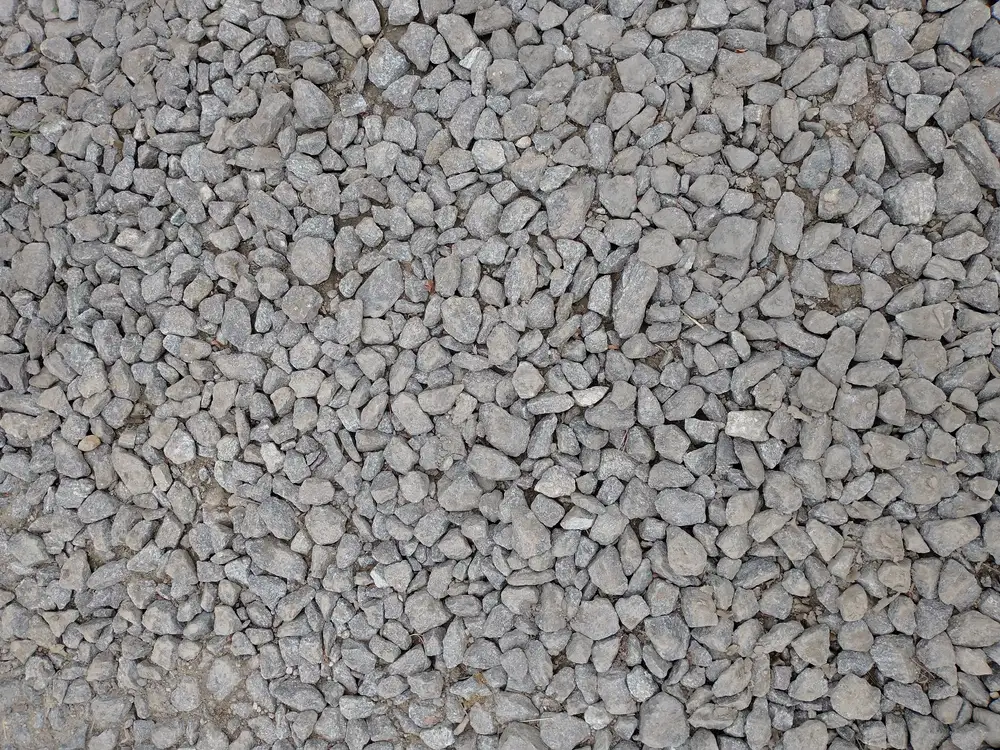
The single most consequential item on the whole quote and the one you can never revisit. Soft material removed, granular fill brought in, compacted in layers rather than in one lift, and graded so water leaves. Slabs that fail early in this county almost always fail from below, and by then the only fix is to take the concrete off and start again.
How deep the concrete is
Four inches suits most residential flatwork. Five or six is right where a heavy vehicle parks. You cannot add depth later; you can only pour a new slab. A patio sits at the shallow end of that range and the depth question there is mostly settled before anyone quotes, which is why a patio quote turns on edges and shape instead.
Whether there is steel in it
Reinforcement is placed before the pour or it does not exist. For a shed pad it is often unnecessary. For anything carrying vehicles it earns its cost, and for concentrated loads it wants designing rather than defaulting.
Where the joints fall
Concrete cracks. That is not a defect, it is a material property. Jointing is how the location gets decided in advance, with each cut running about a quarter of the way through the slab and the pattern settled on paper before delivery day. Leave it unplanned and the concrete picks the line itself.
Get a real number for your slab
Four quick questions and a local concrete contractor will be in touch to set up a free on-site estimate. No obligation, and "just pricing it out" is a perfectly good answer.
Semi-permanent: changeable, but you will pay twice
The surface finish. A broom finish can be ground, stained or coated later, and an overlay can be bonded to sound concrete. None of it is cheap and none of it is quite as good as having chosen the finish at the outset, but it is possible. If the budget is tight today, this is the honest place to economise.
Edges and transitions. Steps, thickened edges and tie-ins to existing concrete can be added afterwards, though the join will always be visible. A step or a border added to an Antioch patio a few summers after the slab is the usual case, and the seam is the price of doing it in two stages. New concrete against weathered concrete never colour-matches.
Ongoing: a choice you keep making
Sealing. Not a one-off. Whether you seal, what with, and how often is revisited every few years for as long as you own the slab. It is genuinely optional on plain concrete and effectively compulsory on decorative work, which is a cost worth counting before you choose a decorative finish.
Winter treatment. What you put on the surface each year does more cumulative damage than almost anything else, and it is entirely within your control.
What this ordering is for
When a quote comes in above what you hoped, the instinct is to take a percentage off everything. The better move is to take it entirely out of the reversible column.
Plain finish now and a decorative treatment in five years is a perfectly good plan. Thin concrete on unprepared ground is not a plan at all, because there is no version of the future where you fix it cheaply. That asymmetry is the whole argument of this page.
What a good slab bid already states
- Slab depth, and whether it is measured over compacted base
- Depth of granular fill and the number of compaction passes
- Whether reinforcement is included, and of what kind
- The joint layout, or a commitment to set one out before pouring
- Air entrainment appropriate to a surface that freezes annually
- Whether excavation spoil and any existing slab are inside the price
One thing that is not on any of these lists
Frost footings. Those belong to structures that carry load, not to flatwork sitting on grade. A slab on grade is meant to move a little with the ground, and it does so harmlessly as long as nothing is fixed to it.
The moment walls bear on the slab, that changes completely and you are into foundation territory with inspections attached. Worth saying out loud before the pour if there is any prospect of a structure going up later, because retrofitting footings under an existing slab is not a job anybody enjoys quoting.
Looking after it
The first year is the one that matters, and new concrete wants treating differently from established concrete. The full schedule is on our driveway cost page and applies to any flatwork.
Sources
- HomeGuide - concrete materials cost against installed slab cost per square foot. Verified 2026-08-18.
- Illinois Ready Mixed Concrete Association - residential slab construction, jointing and care.
- NRMCA CIP 2 - scaling, deicers and freeze-thaw.